










What Is F1?
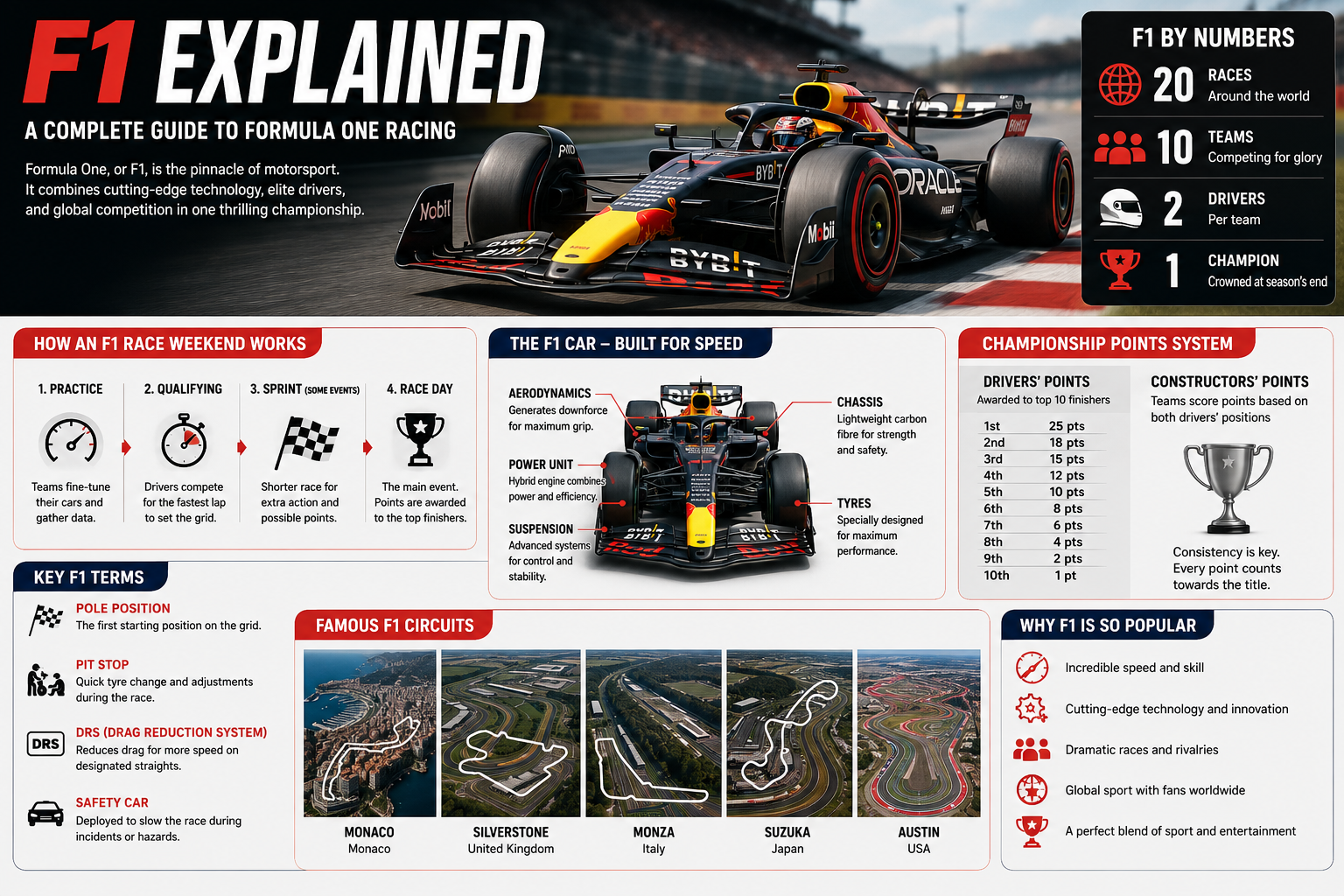
F1, or Formula One, is the highest class of international single-seater motor racing. The term “Formula” refers to the set of rules that all teams and cars must follow.
Each season consists of multiple Grand Prix races held around the world. Drivers compete individually for the Drivers’ Championship, while teams compete for the Constructors’ Championship.
Key characteristics of F1 include:
- Open-wheel racing cars
- Advanced engineering and technology
- Global racing calendar
- Professional teams and drivers
- Strict technical regulations
- High-speed competition
Formula One is governed by the Fédération Internationale de l’Automobile (FIA), the international governing body for motorsport.
The History of Formula One
Origins of F1
Formula One officially began in 1950 with the first World Championship race held at Silverstone in the United Kingdom.
The early years featured legendary drivers and manufacturers that helped shape the sport’s identity.
Evolution Through the Decades
1950s–1970s
- Simpler car designs
- Growing international popularity
- Major advances in engine performance
1980s–1990s
- Introduction of turbocharged engines
- Increased sponsorship and commercial growth
- Improved safety measures
2000s–Present
- Hybrid power units
- Advanced aerodynamics
- Data-driven race strategies
- Greater global reach through digital platforms
Modern Formula One continues to evolve while maintaining its competitive spirit and technological innovation.
How Formula One Works
At its core, Formula One is a championship where drivers and teams earn points based on race results.
The season typically includes numerous races across different countries.
Main Objectives
For drivers:
- Win races
- Score championship points
- Become World Champion
For teams:
- Develop competitive cars
- Maximise race performance
- Win the Constructors’ Championship
Success depends on a combination of:
- Driver skill
- Car performance
- Team strategy
- Reliability
- Weather conditions
Understanding an F1 Race Weekend
One of the most common questions new fans ask is: How does an F1 race weekend work?
Practice Sessions
Teams use practice sessions to:
- Test car setups
- Gather performance data
- Evaluate tyre performance
- Prepare race strategies
Practice allows drivers to familiarise themselves with the circuit.
Qualifying
Qualifying determines the starting grid for the race.
The fastest driver secures pole position, which is the first spot on the starting grid.
Starting near the front often provides a significant advantage during the race.
Sprint Events
Some race weekends feature sprint races.
Sprint events provide additional competitive action and can influence the starting order or points allocation depending on the regulations in place.
Race Day
Race day is the main event.
Drivers compete over a set race distance, usually lasting around 90 minutes to two hours.
The winner is the first driver to cross the finish line after completing the required number of laps.
F1 Teams and Drivers
Formula One teams are responsible for designing, building, and operating their cars.
Each team enters two drivers.
Some of the most recognised teams in F1 history include:
- Ferrari
- McLaren
- Mercedes
- Red Bull Racing
What Makes a Great F1 Driver?
Successful Formula One drivers typically possess:
- Exceptional reflexes
- Physical fitness
- Mental resilience
- Consistency
- Technical understanding
Drivers must perform at extremely high speeds while making split-second decisions throughout a race.
F1 Cars Explained
F1 cars are among the fastest racing machines ever built.
Key Components of an F1 Car
Chassis
The chassis is the main structure of the car and is constructed primarily from carbon fibre.
Power Unit
Modern F1 cars use hybrid power units that combine:
- Internal combustion engines
- Energy recovery systems
- Battery technology
Aerodynamics
Aerodynamics play a crucial role in performance.
Features include:
- Front wings
- Rear wings
- Floor designs
- Diffusers
These components generate downforce, helping cars maintain grip through corners.
How Fast Are F1 Cars?
Modern Formula One cars can reach speeds exceeding 350 km/h on suitable circuits.
Their acceleration, braking, and cornering capabilities are among the most advanced in motorsport.
The Role of Technology in F1
Technology is central to Formula One.
Teams invest heavily in research and development.
Examples include:
- Advanced simulation tools
- Wind tunnel testing
- Real-time telemetry
- Artificial intelligence analysis
- High-performance materials
Many innovations developed in Formula One eventually influence road car technology.
How the Championship Points System Works
Drivers and teams earn points based on finishing positions.
Why Points Matter
Championship points determine:
- Driver standings
- Team standings
- Season champions
Consistency is often just as important as winning races.
Example
A driver who regularly finishes in the top five may outperform a rival who wins occasionally but suffers frequent retirements.
This rewards long-term performance across an entire season.
F1 Rules and Regulations
Formula One operates under strict regulations.
These rules ensure:
- Fair competition
- Safety standards
- Technical consistency
Technical Regulations
Teams must comply with rules covering:
- Engine specifications
- Aerodynamics
- Weight limits
- Safety systems
Sporting Regulations
Sporting rules govern:
- Race procedures
- Penalties
- Pit stops
- Driver conduct
Failure to comply can result in fines, penalties, or disqualification.
Famous Formula One Circuits
Formula One races at some of the most iconic circuits in the world.
Characteristics of Great F1 Tracks
Popular circuits typically offer:
- High-speed sections
- Challenging corners
- Overtaking opportunities
- Unique history
Examples include:
- Silverstone Circuit
- Monza Circuit
- Circuit de Monaco
Each circuit presents unique challenges that test drivers and teams.
Why F1 Is So Popular
Formula One attracts a global audience for several reasons.
High-Speed Action
Fans enjoy seeing the fastest racing cars compete at the highest level.
Driver Rivalries
Competitive rivalries create compelling storylines throughout the season.
Technological Innovation
Many fans appreciate the engineering excellence behind the sport.
Global Appeal
Races take place across multiple continents, helping Formula One attract an international fan base.
F1 vs Other Motorsport Series
| Feature | F1 | IndyCar | Endurance Racing |
|---|---|---|---|
| Car Design | Custom-built | Standardised elements | Multiple classes |
| Race Length | Shorter | Medium | Long-distance |
| Technology | Extremely advanced | More standardised | Reliability-focused |
| Championship Focus | Drivers and teams | Drivers and teams | Teams and manufacturers |
| Global Presence | Worldwide | Mainly North America | International |
Formula One is often considered the most technologically advanced form of motorsport.
How to Start Following F1
If you are new to Formula One, here are some simple ways to get started.
Learn the Teams
Understanding the teams helps make races easier to follow.
Follow Driver Standings
Championship battles add excitement throughout the season.
Watch Race Highlights
Highlights provide a quick way to understand race developments.
Learn Basic Strategies
Pay attention to:
- Tyre choices
- Pit stop timing
- Weather decisions
- Safety car periods
These factors often determine race outcomes.
Practical Tips for New F1 Fans
- Start by learning the top teams and drivers.
- Watch qualifying as well as races.
- Follow championship standings regularly.
- Learn common racing terminology.
- Understand tyre strategy basics.
- Read post-race analysis articles.
- Compare different circuits and racing styles.
The more races you watch, the easier it becomes to appreciate the complexity of Formula One.
Conclusion
Formula One represents the highest level of motorsport competition. It combines elite driving talent, cutting-edge engineering, strategic thinking, and global entertainment into one extraordinary championship.
From understanding how race weekends work to learning about teams, drivers, regulations, and technology, F1 offers endless opportunities for fans to deepen their knowledge and enjoyment of the sport.
Whether you are a complete beginner or an aspiring motorsport enthusiast, following Formula One can be both exciting and rewarding. As the sport continues to evolve through innovation and global expansion, its appeal remains stronger than ever.