










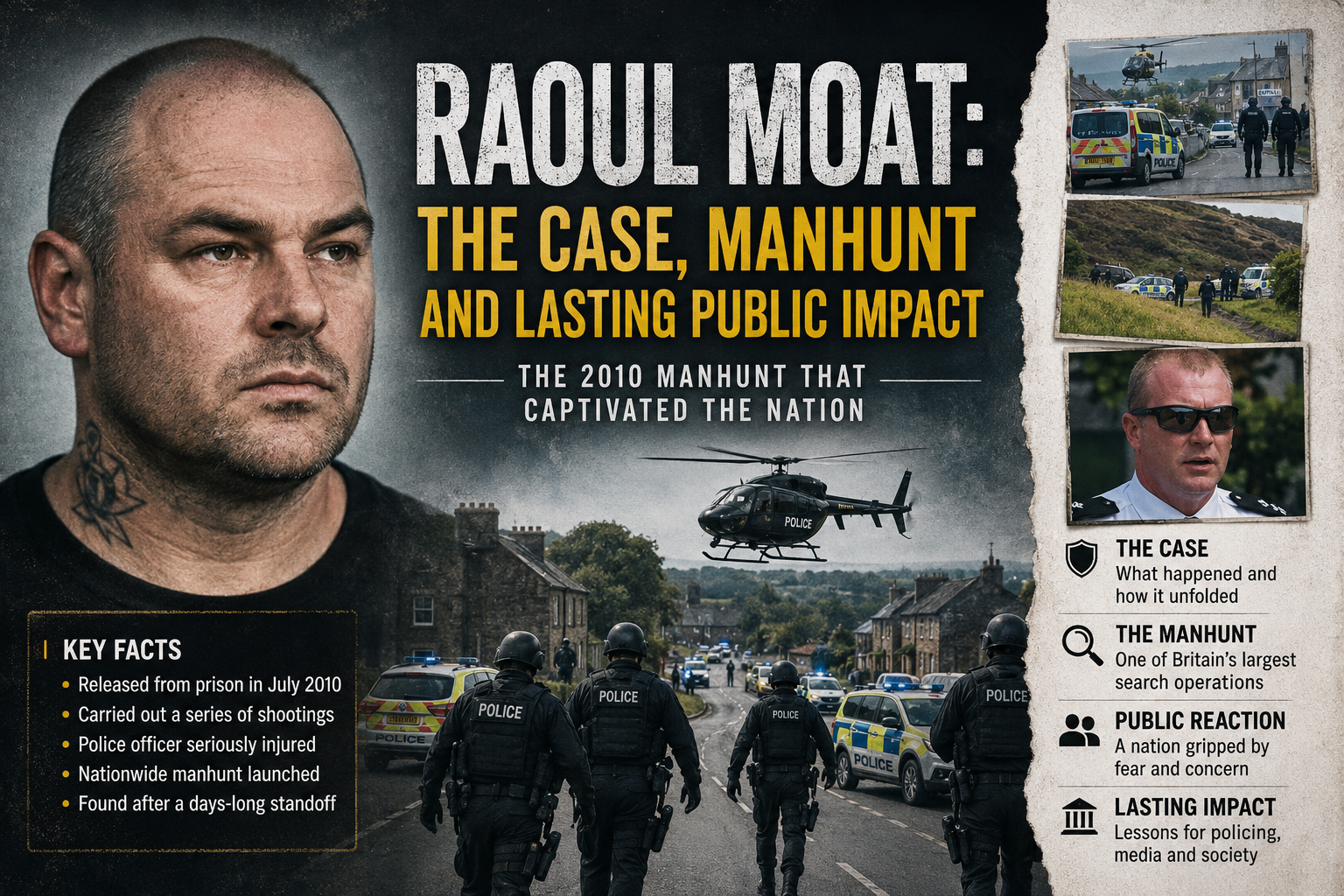
Who Was Raoul Moat?
Raoul Moat was a former nightclub bouncer from Northumberland, England. Prior to the events that brought him national attention, he had a history of violence and criminal offences.
In July 2010, Moat was released from prison after serving a short sentence for assault. Shortly after his release, a series of violent incidents occurred that would lead to a nationwide police operation and widespread public concern.
Although discussions about the case often focus on the manhunt itself, understanding the background helps explain why authorities treated the situation with such urgency.
Events Leading Up to the Case
Several factors contributed to the events that unfolded after Moat’s release from prison.
Personal Circumstances
Reports at the time suggested Moat was experiencing significant personal difficulties, including relationship problems and emotional distress.
Criminal History
Moat had previously been involved in violent incidents and had served prison sentences for offences involving assault.
Escalating Tensions
Following his release, tensions reportedly escalated regarding his former partner and individuals he believed were connected to her.
While these circumstances provide context, they do not excuse the actions that followed.
The Attacks That Shocked the UK
The Raoul Moat case became a national story after a series of shootings occurred in Northumberland.
Attack on Former Partner
One of the first incidents involved Moat’s former girlfriend. She survived the attack but suffered injuries.
Death of Chris Brown
Chris Brown, who was believed by Moat to be connected to his former partner, was fatally shot.
Shooting of Police Officer David Rathband
Perhaps the most widely reported attack involved police officer David Rathband.
While sitting in his patrol vehicle, Rathband was shot and seriously injured. The attack left him permanently blind and sparked widespread public sympathy and support.
The targeting of a police officer significantly increased the urgency of the police response and intensified national attention.
The Nationwide Manhunt
Why the Search Became a National Priority
Following the attacks, police believed Moat was armed and dangerous.
Authorities launched a large-scale search operation involving:
- Hundreds of police officers
- Armed response units
- Specialist negotiators
- Air support
- Search teams
The operation quickly became one of the largest manhunts in modern British policing history.
Public Warnings
Residents in affected areas were warned to remain vigilant.
Police encouraged the public to:
- Report sightings immediately
- Avoid approaching Moat
- Follow official safety advice
The situation created significant concern across communities in North East England.
How Police Responded
Multi-Agency Cooperation
The manhunt required cooperation between multiple police forces and specialist units.
Key objectives included:
- Protecting the public
- Locating Moat
- Preventing further violence
- Gathering intelligence
Use of Specialist Resources
Authorities deployed resources rarely seen in routine criminal investigations.
These included:
- Armed officers
- Search helicopters
- Surveillance teams
- Negotiation specialists
The scale of the operation reflected the perceived threat level.
Negotiation Efforts
Police repeatedly attempted to resolve the situation peacefully.
Negotiators worked to establish communication and reduce the risk of additional harm.
Timeline of Key Events
| Date | Event |
|---|---|
| July 2010 | Raoul Moat released from prison |
| Shortly after release | Series of shootings occur |
| Following attacks | Nationwide manhunt begins |
| Several days later | Moat located by police |
| End of operation | Manhunt concludes after lengthy standoff |
This timeline highlights how rapidly the situation developed and why it attracted such extensive media attention.
Media Coverage and Public Interest
Around-the-Clock News Reporting
The Raoul Moat case dominated television, newspapers, radio broadcasts, and online news platforms.
Key reasons included:
- Public safety concerns
- Ongoing police activity
- Daily developments
- National significance
News organisations provided constant updates as the search progressed.
Growth of Social Media Discussion
The case emerged during a period when social media was becoming increasingly influential in news coverage.
People used online platforms to:
- Share updates
- Discuss developments
- Express opinions
- Follow police announcements
This contributed to unprecedented levels of public engagement.
Challenges for Journalists
The intense public interest created challenges regarding:
- Accuracy
- Privacy
- Responsible reporting
- Verification of information
Many media organisations later reflected on lessons learned from covering fast-moving criminal investigations.
Public Reaction Across Britain
Community Concerns
Communities near the search area experienced understandable anxiety.
Residents were concerned about:
- Public safety
- Potential further attacks
- Police activity in their neighbourhoods
National Debate
The case sparked discussions on several broader issues, including:
- Criminal justice policies
- Mental health support
- Domestic violence awareness
- Firearms-related crime
- Media responsibility
These discussions extended well beyond the immediate events of the manhunt.
Support for Victims
Many people expressed sympathy and support for the victims and their families.
Particular attention focused on David Rathband, whose injuries had life-changing consequences.
Long-Term Impact on Policing
Review of Operational Procedures
Major incidents often lead to reviews of existing procedures.
The Raoul Moat case prompted discussions around:
- High-risk offender management
- Intelligence sharing
- Public communication strategies
- Armed response protocols
Increased Focus on Threat Assessment
Police forces across the UK continued refining methods used to assess potential threats posed by individuals with histories of violence.
Importance of Community Communication
The case demonstrated the importance of clear communication between authorities and the public during major incidents.
Providing timely and accurate information became an even greater priority.
Lessons Learned from the Case
Early Intervention Matters
One of the key lessons highlighted by experts is the value of identifying warning signs before situations escalate.
This includes:
- Monitoring high-risk individuals
- Supporting vulnerable people
- Encouraging reporting of threats
Effective Information Sharing
Successful public safety responses often depend on rapid information exchange between agencies.
The case reinforced the importance of collaboration across organisations.
Responsible Media Coverage
The extensive attention surrounding the manhunt also highlighted the need for responsible journalism.
Media outlets play an important role in informing the public while avoiding unnecessary speculation.
Why the Raoul Moat Case Still Matters Today
More than a decade later, the Raoul Moat case remains relevant for several reasons.
Historical Significance
It represents one of the most widely publicised criminal investigations in modern British history.
Public Safety Lessons
The case continues to be studied as an example of crisis management and police response.
Media and Society
It also provides insight into how media coverage can influence public perception during major events.
Continuing Public Interest
Documentaries, books, and discussions continue to revisit the case, demonstrating its lasting place in British public memory.
Key Facts About the Raoul Moat Case
Quick Summary
- Raoul Moat was a former nightclub bouncer from Northumberland.
- The case began shortly after his release from prison in July 2010.
- Multiple shootings led to a nationwide manhunt.
- Police launched one of Britain’s largest search operations.
- The incident generated extensive media coverage.
- The case continues to influence discussions about policing and public safety.
Conclusion
The Raoul Moat case remains one of the most significant criminal investigations in modern UK history. The attacks, the nationwide manhunt, and the extraordinary level of public interest combined to create a story that captured national attention and left a lasting impression on British society.
Beyond the headlines, the case raised important questions about public safety, criminal justice, mental health awareness, and media responsibility. It also highlighted the challenges faced by law enforcement when responding to rapidly evolving threats.
Today, the Raoul Moat case continues to be remembered not only for the events themselves but also for the lessons learned in their aftermath. Understanding these events helps provide valuable insight into how society responds to major crises and how institutions adapt to improve public protection.